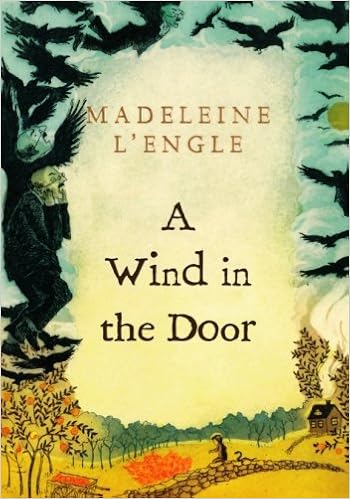
This is the second in a series of five - I read "A Wrinkle in Time" quite a while ago and it is one of my favorite books (although I hardly remember much of it - thus why I've started writing book reviews, to remember how and why different books moved me). A Wrinkle in Time amazed me for its incredible interweaving of science, science-fiction, and faith - it was so unique and I feel as if many books that are popular today, are just (mostly bad) variations of this original.
A Wind in the Door reminded me of this again.
It had been too long ago for me to remember the characters - but I had to assume they were the same ones - Meg was the central character, beginning high school I guess but worrying over her youngest brother, Charles Wallace, who is in first grade and getting beat up everyday because he's different. The father is off in Washington addressing some galactic phenomena, the mother is working on proving the existence of something immeasurable small. They are scientists, and the children are unusual and smart too - they are all open to the unknown especially because of what they know. So when the story begins with Charles Wallace claiming to have seen dragons, Meg believes its what Charles Wallace believes he saw - but she's not so sure it to be true - in fact, she realizes how sick Charles Wallace actually appears. Through several phenomenal events, she is quickly pulled into a fight for Charles Wallace's life and the balance of the universe with her friend Cal, her principal, a cherubim, and a Teacher.
what I liked: Wow. There were many lines I connected with - Meg's "hate" for not loving Mr. Jenkins, which was actually hating herself. The power of being Named. For most of the book I had the Moana song running through my head - when she faced the lava monster in the end, unafraid and sang:
I've crossed the horizon to find you.
I know your name.
They have stolen the heart from inside you.
But this does not define you.
This is not who you are.
You know who you are.
This, along with Greg Boyd's mantra of telling individual's "you are of unsurpassable worth" - it's powerful stuff - for in all of our growth and gain, we are forgetting and losing the most central part of ourselves.
What I didn't like/confused about: Meg's doubt was so redundant. I'm a bit confused about the setting too. They feel and sound British to me - but I think they mention finally New England. The year is confusing too - it sounds modern, but I keep picture an English countryside. When I looked up the books online -even the publishing dates of the series was confusing. This one was published in 1978? There was scene where Mrs. Murry and Dr. Lousie were recalling the man on the moon - and Dr. Louise said Mrs. Murry would have been too young which isn't believable considering she has four kids, and probably more than one PhD, and its confusing too as the characters came across as they same age to me.
Two quotes I'm not sure I agree with:
"Why do people always mistrust people who are different?"
"People are always hostile to anybody who's different."
I think you could make a case for the opposite - that people are drawn to different. There is a type of different that is refreshing, and there is a "different" that we all may not consciously search for, but we know it when we see it.
What I would have like to read: There was was a lot of dialogue indicating urgency and time pressure, but then a lot of continued dialogue. The actual action ended up being very little.
Quotes:
Interesting line: "The gaping rows where once beans had stood, and lettuce, and peas, had a forlorn look; there was an air of sadness and confusion about the carefully planned pattern."
"I think your mythology would call them fallen angels. War and hate are their business, and one of the chief weapons is un-Naming - making people not know who they are. If someone knows who he is, really knows, then he doesn't need to hate. That's why we still need Namers, because there are places throughout the universe like your planet Earth. When everyone is really and truly Named, then the Echtroi will be vanquished."
"Oh, Mr. Jenkins, don't you see? Every time I was in your office, being awful and hating you, I was really hating myself more than you. Mother was right. She told me that you underestimate yourself."
"So you mean on your earth host you never communicate with each other and with other planets? You mean your planet revolves about all isolated in space? Aren't you terribly lonely? Isn't he?"
"He?"
"Or she. Your planet. Aren't you lonely?"
"Maybe we are, a little," Calvin conceded. "But it's a beautiful planet."
"But human beings need Deepening Places, too. And far too many never have any."
"Mr. Jenkins. Unique, as every star in the sky is unique, every leaf on every tree, every snowflake, every farandole, every cherubim, unique: Named."
"'All I need to know is that all the galaxies, all the stars, all creatures, cherubic, human, farandole, all, all, are known by Name.' He seemed almost to crooning to himself."
"The temptation for farandole or for man or for star is to stay an immature pleasure-seeker. When we seek our own pleasure as the ultimate good we place ourselves as the center of the universe. a farm or a man or a star has his place in the universe, but nothing created is the center."
"We are the song of the universe. We sing with the angelic host. We are the musicians. The far and the stars are the singers. Our song orders the rhythm of creation."
'It is only when we are fully rooted hat we are really able to move."

No comments:
Post a Comment